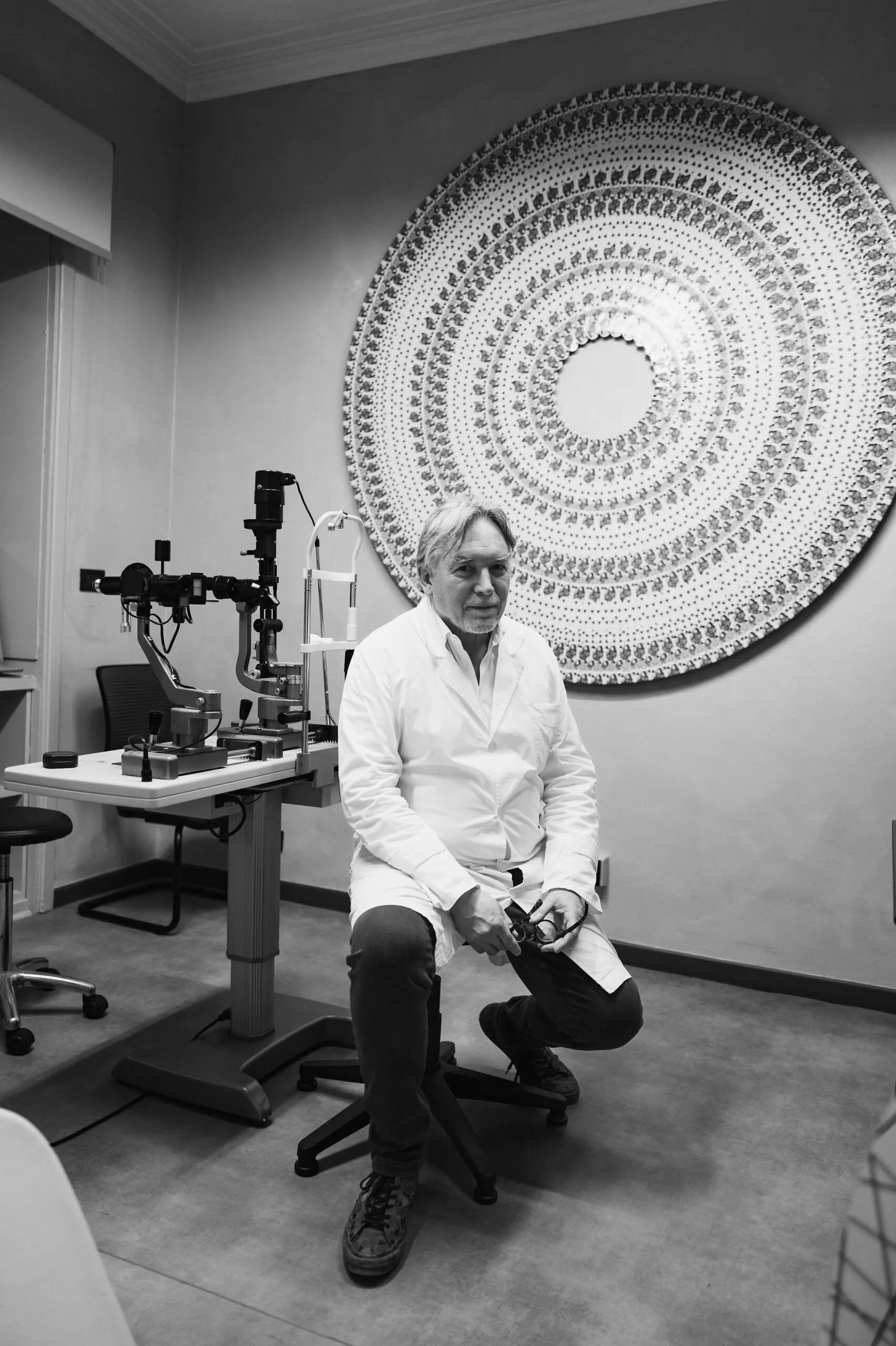
When asked to define himself, Nicola Bolla gives a simple answer: he considers himself a "double" person.
His life moves between two dimensions — art and medicine — not as opposites, but in constant dialogue. On one side, the study of vision. On the other, its questioning.
This duality is not just biographical. It becomes a key to reading his entire work, where every image exists on multiple levels — and never fully coincides with what it shows.
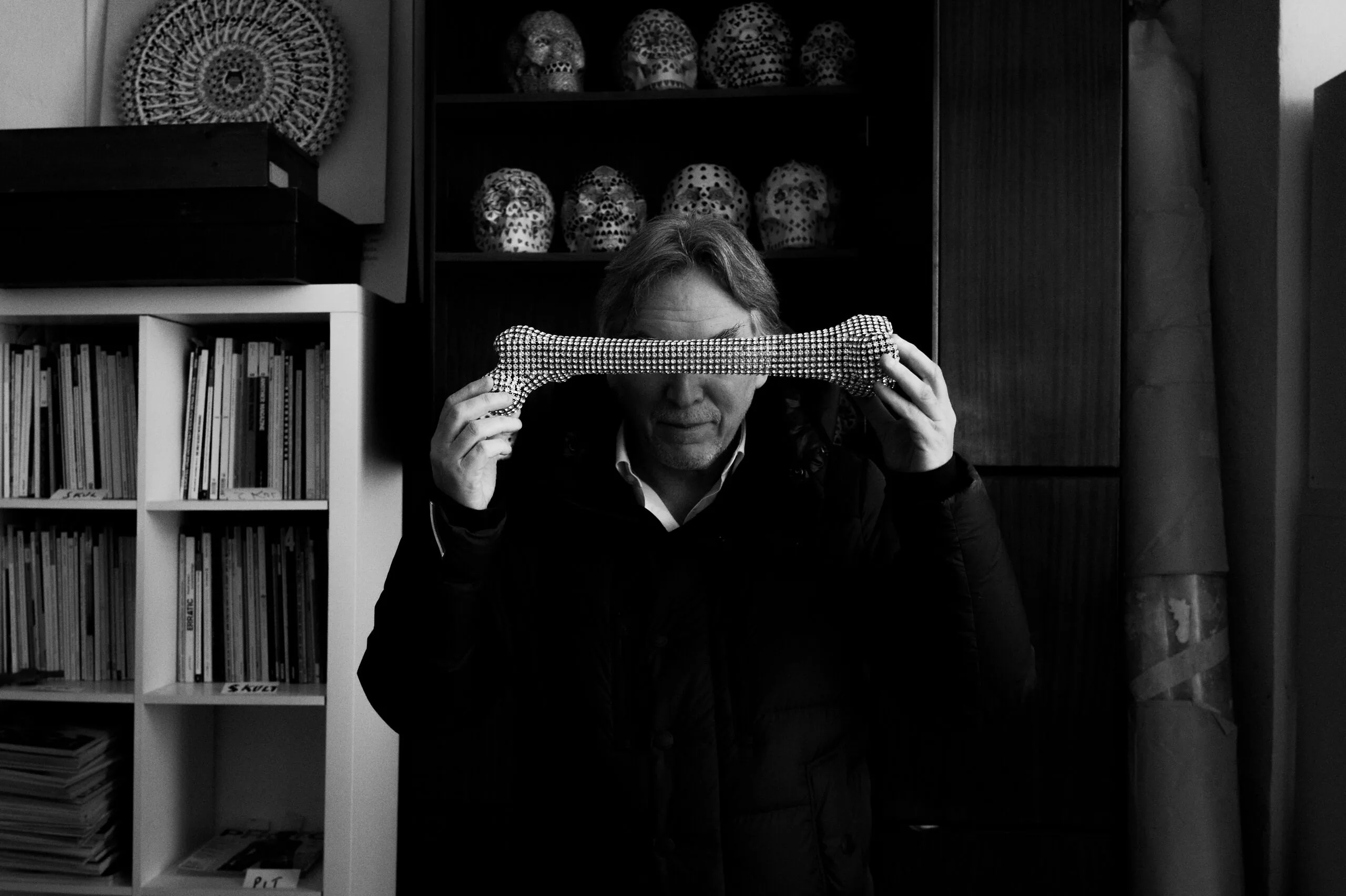
Nicola Bolla creates works that seduce the eye — striking at first glance through light, reflections, and luminous materials: crystals, glitter, pure pigments, playing cards. Elements that immediately evoke value and preciousness, yet in his work are never used as decoration.

Many of these materials don't actually hold the value they seem to suggest. Crystal, for example, recalls a diamond without being one, while glitter captures light — turning it into an active part of the work, and of how it is perceived. This is where his practice takes shape: in ambiguity. What appears precious can be fragile, and what we see never fully coincides with what is.
This way of working is deeply connected to his experience as an ophthalmologist. In his medical practice, he constantly engages with vision, with detail — with everything that is extremely small, yet essential. That is where a certain awareness begins. One that returns in his work: even the smallest element can completely alter the way we perceive what is in front of us.

For this reason, his focus is not the object itself, but the moment it shifts — when it stops being only what we see. It is within this transition that what he defines as a "lateral" vision emerges: a way of looking that does not stop at the surface, but constantly searches for another layer.
This is what the side B represents for him: the less visible part — the one that doesn't reveal itself immediately, yet gives meaning to everything we are looking at.

Nicola Bolla's work is built on images that already exist within our collective memory: icons. He doesn't invent new symbols. Instead, he takes the most recognizable ones — the skull, the atomic mushroom cloud, playing cards, the unicorn — and shifts them into another dimension.

These images, deeply rooted in history and in the collective imagination, become tools to explore something more complex: the distance between what appears and what is.

The skull, for instance, recalls the tradition of vanitas — one of the oldest themes in art history. But in Bolla's work, it is never a simple reference. It becomes a contemporary reinterpretation, constructed through materials and visual languages of the present. For this reason, Nicola has created multiple variations, playing with extravagant headpieces and continuously shifting its perception.

For him, vanitas is not a historical concept. It is a universal condition. We all exist within a constant distance between perception and reality. His work does not explain it. It makes it visible.
Creating is a necessity.
Nicola Bolla's work unfolds as a continuous process. Not an episodic search, but a practice that evolves over time, without interruption.
This continuity creates a particular relationship with his own work. At times, looking back at his pieces, he is surprised by what he has made. He wouldn't always be able to reproduce them in the same way. It is precisely in this loss of control that something essential opens up. The work is never fully predictable. Never fully closed.
For him, an artist should never stop creating. Art must be able to say something that has never been said before.


Painting is the most intimate part of Nicola Bolla's work.
It is where his language takes shape over time, through a direct relationship with matter.
His works never emerge in a single moment. There is always a separation between ground and image: first the space, then what inhabits it. Surfaces become open fields — crossed by marks, pigments, and interventions that accumulate over time. Light is an essential element of his painting. This is why he uses glitter: it reflects light, becoming an active part of the work. The surface is no longer stable. It shifts — depending on the gaze, depending on the position.

Over time, his work has moved from figuration toward a progressive abstraction. It is not a rupture, but a transformation: the initial image is dismantled, pushed beyond the recognizable, until it becomes something else. Bolla works on pre-existing images — covers, exhibition invitations, photographs, books he creates himself — turning them into new working spaces. He always starts from something that already has a form and a meaning, and intervenes by erasing, covering, modifying. It is a complex process, almost a continuous tension between what was there and what remains. The image never completely disappears. It survives as a trace, as an intuition.

In his works on vinyl records, this process becomes even more evident. Bolla takes the image and begins to remove its graphic elements, to deconstruct it, until it becomes something completely different. It becomes impossible to tell where the original image ends and where the painterly intervention begins. It is a work of appropriation and transformation, which he himself describes as a "four-handed process": on one side the artist, on the other an image that imposes its own limits.
This process is never simple. The starting image conditions, resists, imposes a direction. Transforming it without losing it completely requires a precise balance — almost a continuous tension. It is, as he defines it, also a game — but one that requires control, experience, and the ability to push beyond what is already given.
Perhaps this is why Nicola considers his work on vinyl to be his most beautiful.


In his works on vinyl records, this process becomes even more evident. Bolla takes the image and begins to remove its graphic elements, to deconstruct it, until it becomes something completely different. It becomes impossible to tell where the original image ends and where the painterly intervention begins. It is a work of appropriation and transformation, which he himself describes as a "four-handed process": on one side the artist, on the other an image that imposes its own limits.
This process is never simple. The starting image conditions, resists, imposes a direction. Transforming it without losing it completely requires a precise balance — almost a continuous tension. It is, as he defines it, also a game — but one that requires control, experience, and the ability to push beyond what is already given.
Perhaps this is why Nicola considers his work on vinyl to be his most beautiful.


Sculpture enters his practice almost as a challenge, but quickly becomes one of his most recognizable languages.
He works with different materials — bronze, marble, lead. Yet the works made with Swarovski crystals are undoubtedly the most iconic. These works are never closed masses. Nicola does not cover, does not conceal. They are open structures, built through grids and frameworks that allow light to pass through.

This is where a more unstable dimension comes into play. Swarovski — imitating the diamond without being one — reflects light and absorbs the colors of its surroundings, causing the work to shift depending on the space it inhabits.
In Nicola's sculpture, forms are never treated as simple representations. They become structures crossed by light, where the image loses stability and opens up to multiple readings.

Playing cards become, for Nicola Bolla, a true language. They are not a decorative element, but a system developed over time, connected to art history and to the possibility of generating ever-changing combinations.
Each card carries a specific meaning, a precise symbolism. Bolla uses them without a predefined scheme, composing his works progressively and allowing the process itself to guide the construction of the image. He does not limit himself to simple forms such as the square or the circle, but develops more complex structures: prisms, pentagons, open configurations in continuous evolution — as in the case of the still unfinished butterfly.


The cards he uses are mainly rummy cards, which he modifies and personalizes to make his work immediately recognizable. Alongside these, he also uses Salzburg cards, chosen for their strong chromatic presence — intervening on them as well to adapt them to his own language.
Here, too, the theme of transformation returns. The card loses its original function and becomes material, sign, structure. The final image is never fully predictable, but emerges from a subtle balance between control and chance.
Hover to reveal


Tap to reveal
A custom tarot card. A tribute to Nicola Bolla by graphic designer Roberta Bonfardeci.
The card encapsulates Nicola's aesthetic and artistic research, paying homage in particular to his iconic work of the skull covered in Swarovski crystals.
The skull, a universal symbol of the transience of life, is here reinterpreted through the presence of diamonds that emerge and fracture — not as decoration, but as a metaphor for transformation. The precious material, cold and luminous, enters into dialogue with the idea of death, creating a powerful contrast between beauty and dissolution.
The composition recalls the language of tarot, transforming the image into an archetype: no longer a simple representation, but a symbol. Rays, stars, and graphic structure frame the subject like an initiatory card, suggesting a path of awareness.
This card does not speak only of an end, but of mutation — of how even what breaks and disperses can generate light, meaning, and new form.
Nicola Bolla was born in Saluzzo, into a family already immersed in art. His father, Piero Bolla, is a painter. His mother, Silvia Aimone, a set designer. Art is a daily presence — a way of inhabiting the world.
From an early age, he shows a strong inclination for drawing, for manual construction, for invention. He prefers to build his own objects, turning imagination into a concrete gesture.
Painting enters his path early and never leaves it. Around this initial core, his work expands over time, moving across different languages and materials without ever settling in a single direction. In parallel, he pursues medical studies and specializes in ophthalmology.
Over time, his path is not defined by separation, but by continuity: different experiences that stratify and take shape within a single language.


Nicola Bolla's work resists definition within a single form. It does not belong to one material, nor to a specific language.
It does not seek to represent reality, but to transform it. He intervenes on images — modifying them, pushing them beyond their initial meaning.
His works remain open, waiting to be understood, interpreted, questioned.
They do not end in the gaze.
They continue to exist beyond it.